Friday, July 1, 2016

Life is Like an RC Car

First, we got our five-year-old son a REAL radio control car for his birthday April 1st. Real meaning from a Hobby Store (what they call Hobby-Grade cars) not what you buy at Walmart, Target or even Toys R Us. Those all gobble dry cell batteries like I do Cheerios, and break in a week. And did I say SLOW? Tobias had gone through a dozen. All failed and ate batteries except this one; He wouldn’t die.


I thought he’d have a lot of fun with a real car as I coached from the sidelines and told him what and how to do it. As I watched, I realized one thing, I was missing a whole lot of fun.
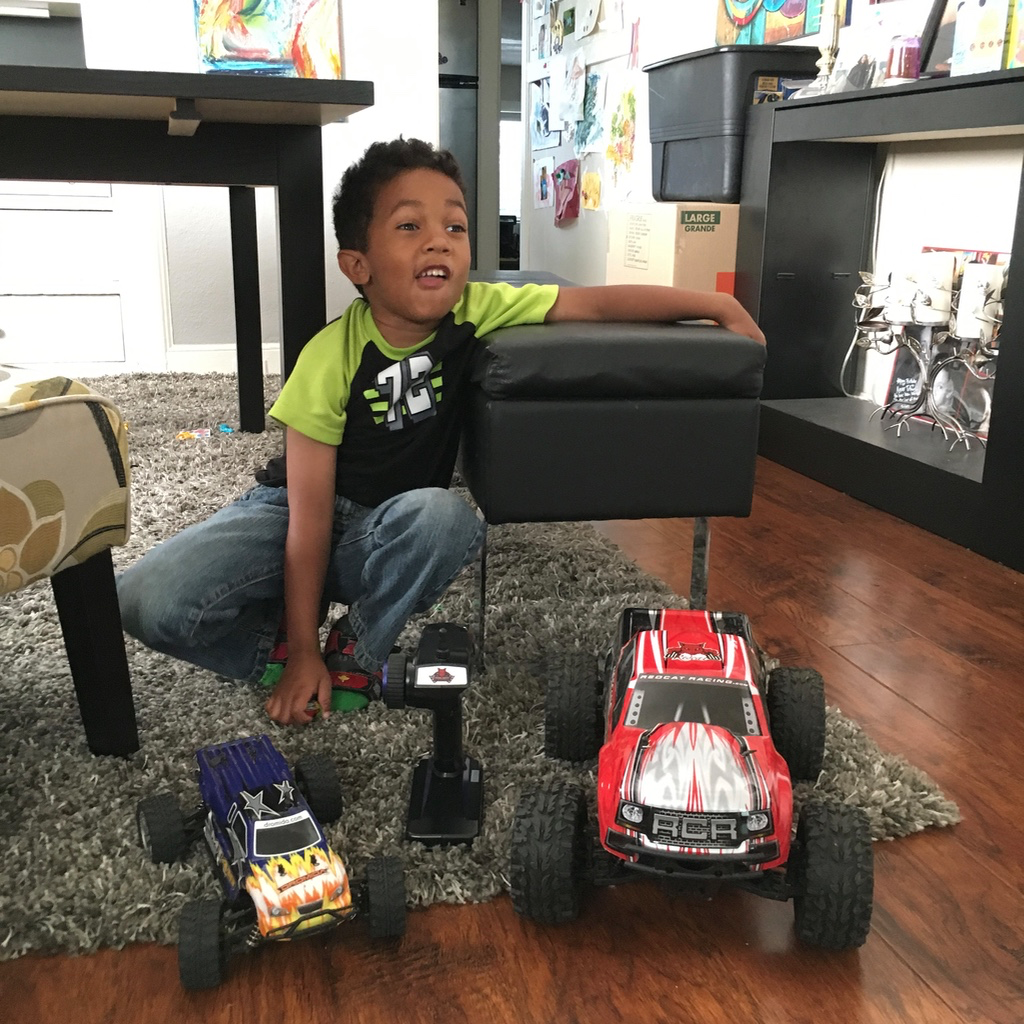
This first car is a 1/18th scale Monster Truck made by Dromida, a division of Revell. In no time at all, Tobias was very good at driving it.
The title of this piece is, Life is Like an RC Car, which brings up my first point.
  • You can sit on the sidelines and watch someone else live life a la TV or Cable News and Reality shows or perhaps even your more adventurous friends. Or, you can get out and live it. Join in the fun.


So, I decided that WE needed a second car. Bigger and better of course. The red one on the right is our second car A Redcat Volcano. The second point in Life is Like an RC Car:
  • We live under the false impression that bigger, faster, and better—is—better.
You do know the answer to this, don’t you?
First day out, that new car dropped a steering hub with no parts locally available. Our new Golden Calf had let us down.
Once it was back up and running (a week later), it proved itself to be a whole lot of fun, but again things started to break. I now know one of the main Axioms of RC cars: They break. Get used to it.
So, anyway having one big car and one little car proved itself a mismatch and less fun than ideal… In comes the second small car. $100 Brand New at RC Country is Sacramento. The fun quotient ramped up once again.


The third point in Life is Like an RC Car:
    One, two, or even three is never enough. Rockefeller (the original) was once asked, “How much money is enough?” The world’s richest man at the time replied, “Just a little more than I have.” Same holds true for RC Cars and all the friends I have made in this hobby/sport, all agree.


'Most' of our stable
Now we have two big ones and two smaller ones and we use them often. Now that we’ve found some cool racetracks, especially Rescue Raceway in Rescue, CA , we want them to run more often which means upgrades. And, did I say faster too?
This brings up the last point I’ll make in my RC Cars as a metaphor of life.
  • Once you get it working, you want it to work better and faster.
    • And once it goes faster, the weaker systems start to break. You beef up that weaker system and now the next weakest fails. Same too in life.
Just when you think you have it all together, the next weakest link will fail. Which will cost you money, sweat, time, and frustration, but it’s worth it.

Or, you could just sit by never change and watch others have all the fun.


Monday, June 20, 2016

True Heroes 2.0

I wrote this piece several years ago while reflecting on the influences that my birth father's life and death, nearly fifty years ago, has had on me up until this day. Uselessly, I lived a maniacally dysfunctional life for far too many years after his death (decades actually).  Thankfully,  the story did not end like that. I was fortunate that another hero came along, and a second father bookended my life. He has also passed on but only after many sacrificial years of demonstrating what authentic heroes are comprised of and how they never die.
To my birth father Elmore 'Matt' Matheson and my second father Howard 'Hank' Smoyer, this piece is dedicated.
Christmas 1959 Mom Dad n Me.jpg
My Birth Dad Left Christmas 1959
Hank Brandy Sheri Christal Mom.jpg
Dad 'Hank Smoyer' with Mom and three of my daughters

~~~True Heroes Never Really Die~~~~


Like a rain-soaked cloud on a stormy day, his death blanketed my mind infusing every pore. My breath felt strangled, and every hope abandoned leaving only sadness in its sloshing wake. My young soul simmered to bursting without any relief in sight.

My dad was gone. Goddamnit!

Ten-year-old boys are not equipped to suffer such a wrenching loss as death which seemed to me to be the main attraction that day. The closing act designed to erase my father’s life from this earth.
Center stage stood the shiny casket amidst garish sprays of flowers you only ever see at horse races—and funerals. I sat neatly filed away between Mom and Grandma, and from there I could see the waxen features of Dad’s strong face protruding from the polished box. Archaic piped-in hymns kept the mood in the room at full-tilt grim, and Death’s boots stomped their indelible print into my miserably shattered soul.

We family members had been segregated well away from the larger gallery of—mere spectators—whose obligation was to be witnesses of our collective grief. A week later they would adjust their lives to do without Ellmore ‘Matt’ Matheson. Five decades (and counting) later he continues to occupy a front row seat in my day-to-day life.

Despite the drowning sadness of that day, my faith was at its peak; I clung desperately to a vain hope that Dad would shake himself awake and climb from that wretched box. Then we could go back home to the wonderful humdrum of our lives.

The crowd queued up to file passed the open casket.
Not me. No, sir. No way.
I WOULD NOT be part of that ghastly parade.

More than one well-meaning relative stopped. With a gentle pat on my hand and a few seemingly kind words, they attempted to coax me into coming along for a look at his corpse as if it was as easy as a trip to the zoo.
What could they have been thinking?
Was tradition so indispensable they found it necessary to heap even more torment onto such a young boy?

A horde of silent whispers grew in my head as I felt every spectator struggling not to look in my direction. Why couldn’t they see that I had the most skin in this game? And a game it seemed to me at the time.

Even though my family and friends were all around me, I felt utterly abandoned. The only person with enough care or courage to sit with me lay stretched out in that casket.
He would have done so whether I was his son or not.

I was an only child, but now had less than nothing.
Why had I been singled out to be cheated of my father?
Where was God while my dad lay dying? (In a hospital room I was deemed too young to visit)
What, besides pure evil (perhaps ignorance) could let a child bounce down such wicked tangents like the jagged rocks of death?

An unfamiliar rage crept like a wolf on the prowl and circled through the dark forest that I was not mature enough to see closing in on me. Life was no longer innocent.
Hunched around its dying fire for warmth, my innocence, and ambient peace was stolen away in such small bites that I wouldn’t recognize what had happened till years later after anger bloomed with a life all its own.

It wouldn't be until twenty-five years following that the fiery bitterness would finally begin to cool. The treasure Dad had stealthily hidden away would finally get to see daylight.

Since that ugly day so long ago, I've amassed a growing corps of personal heroes, yet, compared to a father, they play only minor supporting roles in the story of my life. I look to them to spur my skill, talent, and gifting; to inspire me to strive in character and craft. But, the Drum Major stands his post ahead of them all, and Barely a day goes by without his lessons and examples working their way to the surface of my decisions, actions, and exploits. It’s incredible how much soul Dad was able to pack into the short ten years he guided my growing little life, almost as if he knew his time would be short.

If I die knowing my life had even half as profound an effect on my children and grandchildren as Dad had on mine, my life will have been well lived.

My earliest memory of Dad was when I was three or four years old. Somewhere in Europe, I was hanging from the doorway of a car and peeing into a malevolent rainstorm. He drew enough bravery from me that night to voluntarily dangle from an open door and do my business.

As years went on, he taught me the much more noble art of growing things. I sold produce to our neighbors, grown in my vegetable plot. Still clear in my mind is Dad helping me discover the mystery of black spots that showed up on the leaves of my plants: Charcoal in the soil. Today no one could accuse me of being a good gardener, but how many lessons in commerce, responsibility, and hard work grew in that little garden? Over time, those experiences would grow into factory management and eventual business ownership.

Dad was able to correct my pigeon-toed feet single-handedly by using simple, kind and consistent reminders not to walk like that.
When I show my five-year-old son how to throw a ball, or I must admonish his behavior, Dad still whispers in my ear the right words to say.

On one of many spontaneous early A.M. fishing trips, I remember catching a crab, monstrous-looking by seven or eight-year-old standards. Its fearsome claws awed me, but Dad saw an opportunity for a lesson in courage.
"It's not as scary as it looks," he said.
"Put your finger in the pincers and see."
    I drew back and shrieked, "No!" but Dad exerted the mild pressure it took to get me to do anything he asked, and I put my finger in the claw. Of course, he was right. Just a little pinch. Today I know that most things are fiercer in appearance than in reality.

Anything Dad asked me to do, I would do. And defiance, so commonplace in young people today, was nearly inconceivable for me. His ‘suggestions’ had the power to pull daring, hard work and sacrifice from a timid little boy who would rather not be those things.

Running home one day, from the threats of a bully (older and taller than I) Dad turned me around and marched me back to face Dale Rudd. Up until the very moment that Dad said, “Fight him,” I fully expected he would take care of the menace for me. That battle looked more like a dance than a fight (I’m sure Dad knew it would). Lesson learned—Never back down from a threat, and the slightest temptation to do so sets me to thinking of Dad standing next to me.

He and I built a slot car track out in the garage. It was on a large board with pulleys that could be pulled up to the rafters and out of the way. How many simple things such as the use of tools and more complicated things like patience and persistence do you suppose that project taught me?

My fondest recollections include going to work with Dad during my summer vacations. He had retired after twenty-seven years in the Army and now worked for the Santa Ana Parks Department. Eating lunch with him and his coworkers made me feel much older than my seven years. I spent the day catching frogs while he worked. One day, we took the frogs home in Chinese food containers, and on the ride home in our cavernous four-door blue and white ‘55 Chevy they all disappeared. Those frogs were small but not minute. We never did find them. I imagine him telling that story in heaven and getting laughs all around.

Above all, I think Dad taught me to be kind. It was his standout trait and showed in everything he did. He never explained, it was just part of who he was. You could be sure not to mistake his kindness for timidity or weakness, though. He was never afraid to stand up for himself or an innocent victim of someone else's abuse. He had some strong views on world affairs that wouldn't be very user-friendly today.

In those days, a family outing could simply be to drive around the city or countryside. One of my greatest memories occurred during one of those. Dad accidentally hit and killed a small dog. I remember sitting in the car with Mom as he picked up that dead Wiener Dog and carried it through the neighborhood looking for its owners so he could tell them he was sorry. No further words should be needed here as a testament to his caring, kindness, and strength of heart.

If in the end, I turn out half as kind, compassionate, and brave as Ellmore H. Matheson, I'm good.
   
The bitter memory of not being allowed to visit my dad in the hospital where he died sits aching in my head like an abscessed tooth. I was too young they said. I’m glad it’s not that way today. In that at least, our society has grown more compassionate.
Paramedics’ vain attempts to force my dad to ride the gurney downstairs after a cardiac episode was the last time I physically saw him alive. His repeated remonstrances still ring in my head. Every day that he was in the hospital, I looked forward to talking to him on the phone. I don’t recall what we talked about, but I know both of us fully expected him to come home; until the day, I returned home to a gray room and a tearful mom.

    "Sit here Mikey," she said patting the cushion next to her.

The day of his funeral is still clear as yesterday. I was 10-1/2 years old. No young son should have to bury his father. Unfortunately, for us in this violent, disease prone world, it happens much too often.

   
My unwillingness to view his body did not come from fear. I just refused to see my hero like that. He was Superman strong, and I knew without a doubt that he loved me. He had the answer to every question.

It has taken many years of life in the raw to learn that a hero like him could never actually die but lives on in every breath, decision and deed of my life.

Today he is just as strong if not stronger, and now forty-nine years down the road many of the seeds he planted in the first decade of my life are just now bearing their fruit. That’s a real hero and one that can never truly die.

Epilogue
Many years later, I was an adult stuck in a tailspin; my mom married another great man. It took me several years to recognize and reconcile him as a father to me. But I am glad that I did.
In discussing this thought with a good number of people, I found it hard to find more than a couple individuals (especially men) that had even one GOOD father in their life. I’ve had two and understand my tremendous great fortune.

While writing the original of this piece, my second father was battling cancer from which we all fully expected him to recover. He died just as I was finishing this piece.
Howard “Hank” Smoyer earned the right to be called my Dad. He was not an ‘also ran,’ but another real hero that will never die.

Dad had a love for my Mom, Football, and History. Football never rubbed off on me, but his love of history fueled mine. He shared his books with me most notably the Aubrey-Maturin series by Patrick O'Brian, historical novels about the English Royal Navy set in the Napoleonic era. There was twenty-one in all; he would me mail me one and I would mail it back until I finished them all. The postage cost as much as the book, but we both enjoyed the system.
He was Irish-Catholic to the core and loved Notre Dame.
The minister who spoke at his funeral did not know him. Hank Smoyer was not a churchgoer, but knew his Bible and had a love for God.
The minister interviewed the children of whom there are seven between my Mom's and his own, and came away with this picture:
At the funeral, he said he'd gotten a crystal clear vision of Hank Smoyer and used this text:

Philippians 2:3
Let nothing be done through selfish ambition or conceit, but in lowliness of mind let each esteem others better than himself.

There wasn't a dry eye in the house because everyone knew the minister had nailed it.

Dad was indeed selfless, sacrificial and concerned with others above himself. Even when people betrayed and stole from him, he never gave in to bitterness and never cut them off from his compassion.
Towards the end of his life, no one knew how truly sick he was because he continued to cook, shop and take care of the household and the people around him.
I am sure this is why he only lasted a couple of days at home on hospice care. He did not work well with being taken care of. He told me he had made his peace with God and to see first-hand his love for my Mom was inspiring. Theirs was a flaming hot romance to the end.

Mixed up in the midst of all my madness and trouble, God used two real men to sculpt my life, and they are carving away still.
True heroes can never really die.


Monday, June 13, 2016

Night Over Water by Ken Follett

Multi-layered and fascinating read.

Crime, intrigue, espionage, instant romance, and fleeing spouses not to mention backstabbing business partners. This novel will not disappoint and is worth every penny whether you purchase the Kindle version or the paperback.

Night Over Water has it all, and Ken Follett has done a masterful job of weaving a story set on the brink of World War II. 

The Pan American Clipper a transatlantic luxurious seaplane based on some nearly lost aviation history sets a captivating scene for this wonderful tale.
 Flying Boats

At no time during the story was the end predictable. A great tale.

Thursday, March 31, 2016

True Heroes Never Die

I originally wrote this piece three years ago while reflecting on the ongoing effects of my birth father's life and death nearly fifty years ago. And, the maniacally dysfunctional life I lived for too many years after his death.  The story did not end like that, thank God. I was fortunate that another hero came along, and my life became bookended by a second father. He also passed on, but only after many sacrificial years of demonstrating what authentic heroes are composed of and how they never die.
To my birth father Elmore 'Matt' Matheson and my second father Howard 'Hank' Smoyer, this piece is dedicated.
July 2, 1960 My Fourth Birthday

~~~True Heroes Never Really Die~~~~

Like a rain-soaked cloud on a stormy day, his death blanketed my mind infusing every pore. My breath felt strangled, and every hope voided leaving only sadness in its wake. My young soul simmered to bursting, but without any relief in sight.
My dad was gone. Goddamnit!
Ten-year-old boys are not equipped to suffer a wrenching loss such as death. That was the main attraction this day. The closing act designed to erase my father’s life from this earth.
Center stage surrounding the shiny casket stood garish sprays of flowers you only ever see at horse races—and funerals. From where I sat neatly filed away between Mom and Grandma, I could see the waxen features of Dad’s strong face protruding from the polished box. Archaic piped-in hymns kept the mood at a full-tilt grim, and Death’s boots stomped an indelible print into my miserably shattered soul.
We family members were segregated well away from the larger gallery of—mere spectators—those obligatory witnesses to our collective grief. A week later they would adjust their lives to do without Ellmore ‘Matt’ Matheson. Five decades (and counting) later he continued to occupy a front row seat in my day-to-day life.
Despite the drowning sadness of that day, my faith was at its peak; I clung desperately to a vain hope that Dad would shake himself awake and climb from that wretched box. Then we could go back home to the beautiful humdrum of our lives.
The crowd queued up to file passed the open casket. Not me. No, sir. No way.
I WOULD NOT be part of that ghastly parade.
More than one well-meaning relative stopped, and with a gentle pat on my hand encouraged me to come along and view his corpse. What could they have been thinking? Was convention so indispensable they found it necessary to heap even more torment onto such a young boy?
A horde of silent whispers grew in my head as one by one every spectator struggled not to look in my direction. Couldn’t they see that I had the most skin in this game?

And they were worried about tradition!

Surrounded by my family and friends, I felt utterly abandoned and the only person with enough care or courage to sit with me that day and say, "Everything will be alright," lay stretched out in the casket. He would have done so whether I was his son or not.
I was an only child, but now had less than nothing. Why had I been singled out to be cheated of a father? Where was God while my dad lay dying? (In a hospital room I was deemed too young to visit)
What, besides pure evil (perhaps ignorance) could let a child bounce down such wicked tangents as those jagged rocks of death? An unfamiliar rage crept like a wolf on the prowl circling through the dark forest closing in on me. Life was no longer innocent.
The Outlaw 1985
Hunched around its slowly dying fire for warmth, my innocence, and ambient peace were stolen away in such small bites that I wouldn’t recognize what had happened till years after anger bloomed with a life all its own. It wouldn't be until twenty-five years later that the fiery bitterness would finally begin to cool. The treasure Dad had stealthily hidden away would finally see daylight.
Since that ugly day so long ago, I've amassed a growing corps of personal heroes, yet, compared to a father, they play only minor supporting roles in the story of my life. I look to them to spur my skill, talent, and gifting; to inspire me to strive in character and craft. But, the Drum Major stands his post ahead of them all. Barely a day goes by without his lessons and examples working their way to the surface of my decisions, actions, and exploits. It’s incredible how much soul Dad was able to pack into the short ten years he guided my growing little life, almost as if he knew his time would be short.
If I die knowing my life had even half as profound an effect on my children and grandchildren as Dad had on mine, my life will have been well lived.
My earliest memory of Dad was when I was three or four years old. Somewhere in Europe, I was hanging from the doorway of a car and peeing into a malevolent rainstorm. He drew enough bravery from me that night to voluntarily dangle from an open door and do my business.
As years went on, he taught me the much more noble art of growing things. I sold produce to our neighbors, born from my vegetable plot. Still clear in my mind is Dad helping me discover the mystery of black spots that showed up on the leaves of my plants: Charcoal in the soil. Today no one could accuse me of being a good gardener, but how many lessons in commerce, responsibility, and hard work grew in that little garden? Over time, those lessons would grow into factory management and eventual business ownership.
818 Mantle Lane Santa Ana, CA 1962

Dad was able to correct single-handedly my pigeon-toed feet by simple, kind and consistent reminders not to walk like that. When I show my toddler son how to throw a ball or I must admonish his behavior, Dad still whispers in my ear the right words to say.
On one of our many spontaneous early A.M. fishing trips, I caught a crab, a monster by seven or eight-year-old standards. Its fearsome claws awed me, but Dad saw an opportunity for a lesson in courage.
"It's not as scary as it looks," he said. "Put your finger in the pincers and see."
I drew back with a fearful, "No!" Dad exerted the mild loving pressure it took to get me to do anything, and I put my finger in the claw. He was right of course. Just a little pinch. Today I know that most things are fiercer in appearance than they are in reality. Anything Dad asked me to do, I would do. And defiance, so commonplace in young people today, was nearly inconceivable for me. His ‘suggestions’ had the power to pull daring, hard work and sacrifice from a timid little boy who would rather not be those things.
Running home one day, from the threats of a bully (older and taller than I) Dad turned me around and marched me back to face Dale Rudd. Up until the very moment that Dad said, “Fight him,” I fully expected he would take care of the menace for me. That battle looked more like a dance than a fight (I’m sure Dad knew it would). Lesson learned- Never back down from a threat, the slightest temptation to do so sets me to thinking of Dad standing next to me.
He and I built a slot car track out in the garage. It was on a large board with pulleys that could be pulled up to the rafters and out of the way. How many simple things such as the use of tools and more complicated things like patience and persistence did that project teach?
One of my fondest recollections was going to work with Dad during my summer vacations. He retired from 27 years in the Army and now worked for the Santa Ana Parks Department. Eating lunch with him and his coworkers made me feel much older than my seven years. I spent the day catching frogs while he worked. We took the frogs home in Chinese food containers, and on the ride home in the cavernous four-door blue and white ‘55 Chevy they all disappeared. They were small but not minute. We never did find them.
Me and Grandkids 2010ish
Above all I think Dad taught me to be kind. It was his standout trait and showed in everything he did. He never explained, it was just part of who he was. You could be sure not to mistake his kindness for timidity or weakness, for he was never afraid to stand up for himself or a victim of another's abuse. He also had some very strong views on world affairs that wouldn't be very user friendly today.
In those days a family outing could simply be to drive around, and on one of these Dad accidentally hit and killed a small dog. I remember sitting in the car with Mom as he picked up that dead Wiener Dog and carried it through the neighborhood looking for its owners so he could tell them he was sorry.
If, in the end, I turn out half as kind and compassionate as Ellmore H. Matheson, I'm good.
The bitter memory of not being allowed to visit my dad in the hospital where he died still sits aching in my head like an abscessed tooth. Too young they said. I’m glad it’s not that way today.
In that at least our society has grown more compassionate.
Paramedics’ forcing him to ride the gurney downstairs was the last time I physically saw my dad alive. His repeated remonstrations to allow him to walk down the stairs still ring in my head. Every day he was in the hospital, I looked forward to talking with him on the phone. I don’t recall what we talked about, but I know both of us fully expected him to come home. Until the day I returned home to a gray room and a tearful mom.
"Come sit here Mikey," she said patting the cushion next to her.
The day of his funeral is still clear as yesterday. I was 10-1/2 years old. No young son should have to bury his father. Unfortunately, for us in this violent, disease prone world, it happens much too often.
I wasn't frightened (in the squeamish sense) to view his body, but refused to see my hero so powerless. He was superman, strong and without a doubt loved me. He had the answer to every question. How could he do so from that box? It has taken many years of life in the raw to learn that a hero like him could never really die, but lives on in every breath, decision and deed of my life.
Today he is just as strong if not stronger, and now 48 years down the road many of the seeds he planted in the first decade of my life are just now bearing their fruit. That’s a true hero, and one that can never really die.

Epilogue

Many years later, when as an adult I was stuck in a tailspin, my mom married another great man. It took me several years to reconcile him as a father to me. But I did.
From Left My Daughter Sheri, Brandy, Mom, Dad Hank, Christal
In discussing this thought with a good number of people, I found it difficult to locate more than a couple that have had even one GOOD father in their life, and I’ve had two.
I understand my tremendous good fortune.
While writing the original version of this piece my second father was battling cancer from which I fully expected him to recover. He died just as I was finishing.
Howard “Hank” Smoyer earned the right to be called my Dad. He was not an ‘also ran,’ but another real hero that will never die. It would take another story to tell you why.
Mixed up in the midst of all my madness and trouble, God used two real men to sculpt my life, and they are carving away still, for true heroes never really die.
Tobias and I


Saturday, March 5, 2016

EENY MEENY Book Review

Bone-Jarring * Brutal * Intense

Great piece of crime fiction by M. J. Arlidge. 
Not your usual fair (Cliche I know, but it's true)– Detective Inspector Helen Grace pursues a twisted serial killer. The story setting is the English coastal city of Southampton. Grace is a tough, determined police officer who rides a motorbike and prefers to travel through life alone; she nevertheless is beset by personal demons. The killer is kidnapping pairs of victims and torturing them in ways that to tell you would be a spoiler. The identity of the predator unveiled only in the last ten percent of the book comes entirely unexpected.


Much like an out of control car careening towards you on a rainy night, some aspects of this story can be seen coming; nevertheless, they were unique as fingerprints. Piece by jagged piece added up to a chilling razor-sharp tale, and the story never lagged. The cold brutality of the action was felt in every letter of sparing descriptions which were never gratuitous. At times, my stomach lurched at the vivid depictions. The only distraction or complication I felt was a purely American one, the British idioms lent realism but confused me more than once.
Great story.

Monday, February 22, 2016

The Day The Mockingbird Died

Harper Lee, author of the nearly ubiquitous modern American classic, To Kill a Mockingbird, died Friday, February 19, 2016. But, of course, you know this already – unless you live in a cave – without a cell phone.


This article is not meant to be an encyclopedia of facts, for that you can go to Wikipedia.  Still, I would like to throw out a few astounding facts.

If you went to High School any time since the 1960s, you could hardly escape without reading her iconic book, or at least, cheating and stealing the Cliff Notes. I missed out only because school seemed uninteresting and nefarious activities were the bigger draw at the time. I did read it later in life.

A 2008 survey of secondary books read by students grades 9–12 in the U.S. indicates the novel is the most widely read book in these grades. My granddaughter read Mockingbird when she was fifteen-years-old (now you know I'm an old codger), and she can engage anyone in a compelling debate on the merits of Harper Lee's first and almost only book. It is her favorite book of all time, and she is a voracious reader.

Miss Lee's second novel, Go Set a Watchman, was written in the mid-1950s and published in July 2015 as a "sequel" though it was later found to be Mockingbird's first draft.

As an Indie Author, this next one kills me, not as funny haha, but WHY-NOT-ME (I know the answer shush): Harper Lee won a Pulitzer for her first book. Granted, she deserves it.

Mockingbird, since 1960 has sold at least a million copies a year.

And, if all that is not enough, read the following paragraph from Wikipedia on the novel's contribution to the success of the Civil Rights movement. That alone makes Harper Lee's image worthy to be inscribed on Mount Rushmore:
The novel is cited as a factor in the success of the civil rights movement in the 1960s, however, in that it "arrived at the right moment to help the South and the nation grapple with the racial tensions (of) the accelerating civil rights movement". Its publication is so closely associated with the Civil Rights Movement that many studies of the book and biographies of Harper Lee include descriptions of important moments in the movement, despite the fact that she had no direct involvement in any of them. Civil Rights leader Andrew Young comments that part of the book's effectiveness is that it "inspires hope in the midst of chaos and confusion" and by using racial epithets portrays the reality of the times in which it was set. Young views the novel as "an act of humanity" in showing the possibility of people rising above their prejudices. Alabama author Mark Childress compares it to the impact of Uncle Tom's Cabin, a book that is popularly implicated in starting the U.S. Civil War. Childress states the novel "gives white Southerners a way to understand the racism that they've been brought up with and to find another way. And most white people in the South were good people. Most white people in the South were not throwing bombs and causing havoc ... I think the book really helped them come to understand what was wrong with the system in the way that any number of treatises could never do, because it was popular art, because it was told from a child's point of view."

I finished reading/listening to her second novel Go Set A Watchman (published fifty-five years after her first) on the same day she went off into eternity, and only learned the sad news of her death.


Parked outside of Starbucks, I was scrambling in the console for a napkin and a pen before looking online for a bit of text from Watchman (so I wouldn't have to scribble or type it myself).

The text that HITS me after listening to Doctor Finch slap Jean Louise (Scout from Mockingbird) hard enough to draw blood:
I never struck a woman before in my life. Think I'll go strike your aunt and see what happens. You just sit there for a while and be quiet.- Chapter 18
Now that's a line that reaches up, grabs you by the shirt collar and slams your head into a wall.
Bravo to the author. I'm not advocating violence against women, but that's a great line.
There's a lot of controversy surrounding Lee's second novel, and some people are whining that Atticus Finch, a pen and ink icon for good in the Twentieth Century, is discovered to be a racist (not a bigot but a racist–Read the book or get a dictionary). I saw a tweet saying that was a violation akin to Spielberg doing a sequel and having ET punch Elliot in the face. Perhaps.

Anyhow, Miss Harper Lee is a gift that will endure. As a writer or reader, you must, or I'll slap YOU to see what happens, admire her for earning a Pulitzer on her first book changing our world for good then publishing another fifty-five years later before riding quietly off into the sunset.

May we enjoy her gifts for years to come.

I am in awe.
Peace,
M